Full text
Share
|
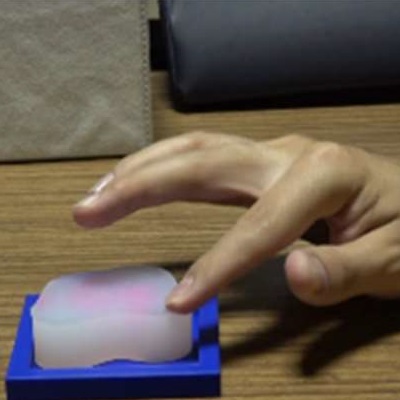
AbstractPerception through touch relies on active exploration strategies that adapt to perceptual goals and object properties. We investigated how information gathering through exploratory procedures (EPs) is organised in haptic shape perception, in particular with respect to the selection of EPs and the prioritisation of shape features - and how these processes are influenced by material properties. In two experiments, participants used a single finger to explore rigid or deformable shapes and judged shape similarity. In Experiment 1, analysis of EPs showed that while contour-following was the dominant strategy for acquiring shape information, participants flexibly supplemented it with additional EPs such as tapping and scanning when exploring deformable shapes. In Experiment 2, trajectory and force data showed a mostly consistent prioritisation of concave regions across exploration parameters (dwell time, velocity, distance, force), regardless of material. Force was modulated by material properties, with participants applying more force to rigid shapes and less to deformable ones. Analysis of the temporal sequence of movements further showed comparable contour following patterns across materials, but slightly more fragmented movements for deformable shape and smoother, more complete contour tracing for rigid ones, and some shape-specific effects. Together, the findings demonstrate that haptic shape perception is both adaptive and structured: exploratory strategies adjust to material contexts, yet perception and exploration remain anchored by stable geometrical cues, particular concavities, supporting reliable shape perception across contexts. |