Full text
Source code
Share
|
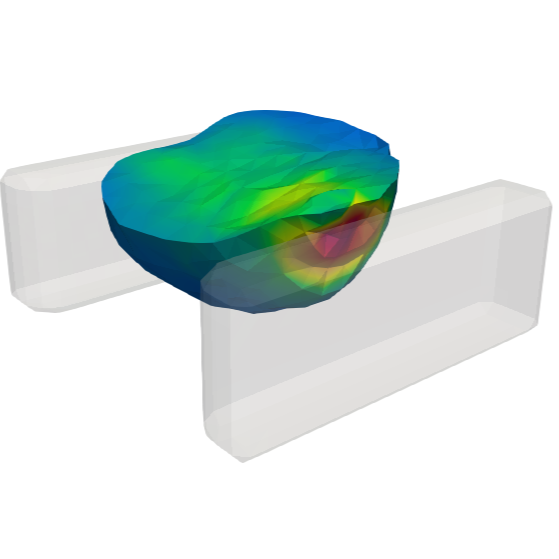
AbstractHumans handle and manipulate soft, deformable objects effortlessly, but robot skill in this domain lags behind. One of the major challenges in robotic manipulation of deformable objects arises from the difficulty of predicting the deformation and stress fields. The gold standard for modeling the physics of deformable objects, and predicting deformation and stress fields, is the computation-heavy Finite Element Method (FEM). Recent advances such as Graph Neural Networks (GNNs) enable learning such fields with high accuracy. We base our work on the DefGraspNets model, of which we identify key limitations: First, the network predicts stress values at mesh vertices, which is not in line with the physical model of FEM. Second, high mesh resolution and low number of message passing rounds prohibit propagation of information through the entire graph, which hurts performance in edge cases. To overcome these limitations, we propose two modifications as inductive biases to the GNN: Tetrahedron features for predicting values directly at tetrahedrons, and a global feature as shortcut for information relevant to the whole graph. Our results, evaluated with FEM-simulated datasets of grasps on different objects, show that our method outperforms the baseline on nearly all objects, enabling more accurate and physically more realistic predictions. We release our codebase: fheller1.github.io/tetgraspnets |