Full text
Share
|
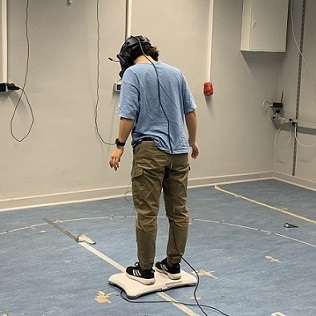
AbstractExposure to height induces pronounced changes in human postural behavior, yet the computational mechanisms underlying these adaptations remain unclear. Previous studies report both reduced and increased postural sway under height exposure leading to seemingly contradictory interpretations. Here, we apply inverse optimal control (IOC) to infer how control objectives governing postural behavior are reweighted under threat. Participants performed quiet standing in a virtual reality environment under ground and height conditions while joint-level kinematics were recorded. Postural control was modeled as a multi-joint optimal control problem with fixed dynamics, and condition-specific cost weights on joint velocity and control effort were inferred. Height exposure was associated with increased penalization of joint angular velocity and altered effort weighting, consistent with more conservative control strategies. Substantial inter-individual variability was observed. Moreover, anxiety-related measures were linked to increased control variability, whereas fear of heights and heart-rate change were associated with motion-suppressive control. We thus provide computational evidence for a functional dissociation between fear of heights and anxiety in human balance control. |