Full text
DOI
Share
|
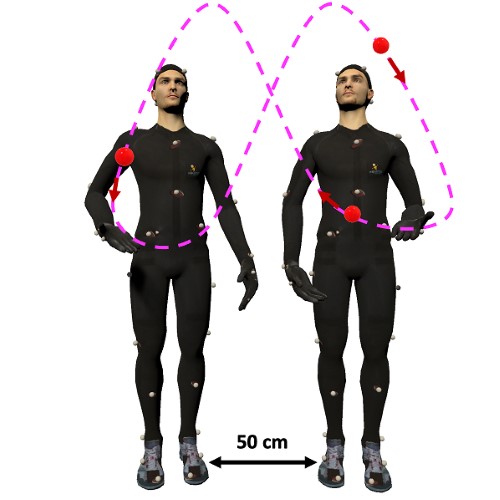
AbstractIntercepting a moving object with our hands requires that the moving object and the hand come into contact at some point along the object’s trajectory. Hand movement can be planned in advance so that the hand reaches the interception location along this trajectory at the correct moment in time. To enable such anticipatory behavior, the object’s trajectory may be predicted based on sensory information collected before movement planning is concluded. Early completion of planning would allow for a smooth and economical movement; however, it also requires sufficiently accurate information about the object’s movement to be available earlier. We investigate interception in the context of a complex, naturalistic motor task, toss juggling, to understand the extent to which proprioceptive and tactile information influence anticipatory movements of the catching hand. In our study, we compared solo juggling, where the efferent, tactile and proprioceptive information from the throwing hand is available during catch planning, with dyadic juggling, where no such information is available because the ball has been thrown by another person. Our results indicate that when internal and tactile information from the toss is absent, anticipatory behavior is significantly reduced. Toss jugglers seem to rely more strongly on internal information than vision, allowing earlier planning and lower target uncertainty. In the dyadic condition, when internal information is absent, trajectory planning is delayed, leading to greater target uncertainty. |