Full text
Share
|
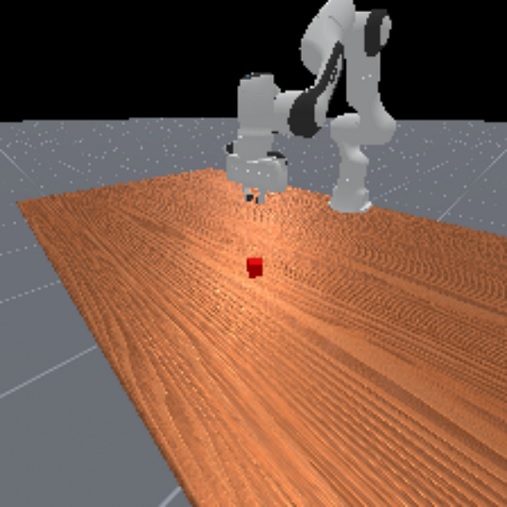
AbstractRobotic manipulation policies rely on pre-trained vision models that give either a global scene embedding or a dense patch grid. Both mix task-relevant and task-irrelevant features. Object-centric slot representations are a structured alternative: they group features into a few per-object slots. We test what this structure buys on ManiSkill3 PickCube-v1, with a frozen encoder and a held-out-seed evaluation. Holding the policy, goal token, rendering, and calibration fixed and changing only the encoder, a frozen object-centric SPOT representation (DINO ViT-B/16 + Slot Attention) reaches 55.0+/-2.9% success, 22.4% above a dense DINO global-feature baseline (32.6+/-1.5%), with the same trainable policy and no encoder fine-tuning. More tokens alone do not help: a dense patch grid with 16x the tokens performs no better than the global feature. Adding an explicit 2D spatial goal and native-resolution rendering raises the full system to 68.7+/-4.2%, just below a privileged 3D-oracle upper bound (71.7+/-4.1%). An automated kinematic failure taxonomy then separates spatial-precision (Near-Miss) failures from object-tracking (No-Grasp) failures: spatial grounding reduces Near-Miss while leaving No-Grasp unchanged. The same taxonomy transfers to the harder StackCube-v1 and points to occlusion as the main bottleneck. |